

WEALTHERY
Your investment app that doesn't make you feel dumb, empowered. Handcrafted for rebels: modern finance stripped of jargon and rebuilt with clarity, attitude, and a bit of graph paper.
Role
Lead UX Designer
Duration
Oct – Dec 2024
Tools
Figma · Dark UI · Data Viz
Type
Fintech · Mobile App
Meet Wealthery.
ok so… investing apps are kind of a mess.
You open Groww. You see 47 numbers. You close Groww.
CAGR? P/E ratio? NAV? All on the first screen, with no way to ask what they mean without feeling stupid.
Gas fees, withdrawal penalties, and "maintenance costs" surface only once your money is already in.
Derivatives and order books are front-loaded onto users who just wanted to beat inflation.
"I just wanted to beat inflation, not get a PhD in Finance."
Status quo: retained
Three types of people. One app.
Traditional banking is for everyone. Wealthery is for the specific, the gatekept, the curious, and the restless.
Aarav · 25
Newbie / Scared · Bengaluru
"Everything I read about stocks feels like a different language. I'm afraid of clicking the wrong button and losing my savings."
Need: Extreme clarity. No jargon, just clear paths, he treats his portfolio like a fragile glass sculpture.
Kavya · 30
Intermediate / Ready · Hyderabad
"I've got the basics down, but my bank's app is so slow. I want to try options but the UI makes me want to scream."
Need: Speed and leverage. She's done with hand-holding and wants to build real lifestyle freedom.
Raghav · 40
Pro / Control · Mumbai
"Stop hiding my fees. I'm tired of 'traditional' advice that only serves the banks."
Need: Total control. He values customisation and API access over pretty onboarding screens.
Whoever you are, the old ways are broken. See the solution we built for them.
We actually asked people. Wild, right?
A mixed-methods sprint, 3 weeks, 60 participants: 50 survey respondents and 10 in-depth interviews. We took it to the streets to understand why the current financial system feels like a VHS tape in a 4K world.
Users are tired of waiting for transactions to settle. They want data as it happens.
Transparency isn't a feature anymore, it's the requirement. No more costs buried in fine print.
Jargon is the enemy. Two out of three users drop off when things start sounding like a law textbook.
Guidance over control. Users want to learn how to play the game, not have it played for them.
Survey signal · 50 participants
| Finding | Share | Design implication |
|---|---|---|
| Felt overwhelmed by terminology | 80% | Tap-to-explain glossary on every term |
| Fear of making a permanent mistake | 70% | Confirmation friction on high-stakes actions |
| Preferred human advice over UI | 65% | Community + expert learning surfaces |
| Trust issues with digital-only firms | 60% | Fee breakdowns as first-class UI |
Ten qualitative interviews ran alongside the survey to explain the why behind each number.
"I have the money, but when I see all those graphs and charts, I feel like I'm entering a cockpit without a licence. I just close the app."
First-time investor, 26
"The KYC process asked for documents I didn't even know I had. Why can't it just be as simple as ordering food?"
Tech professional, 31
"I don't need a thousand options. I just need to know if this specific fund will help me buy a house in 5 years."
Married professional, 34
Here's what broke everything down.
A system built on graph paper.
Surface Dark
Brand Teal
Brand Amber
Surface Light
Profit
Loss
40px / 700
28px / 600
16px / 400
12px / 500 · tracked
An 8pt grid on a visible graph-paper backdrop, the interface reads like a strategy notebook, not a trading terminal.
Wireframing the core flows.
Low-fidelity wireframes focused purely on layout hierarchy, information architecture, and user movement, without the distraction of aesthetic styling. This ensured the UX foundation was sound before any brand assets went on top.
Architectural note: these were intentional structural decisions to reduce cognitive load in financial decision-making. Data density lives in the dashboards; extreme clarity governs every transactional flow.
Five-tab structure
Wealthery
├── Home, greeting, learning cards, bank linking, notifications
├── Portfolio, holdings, allocation, performance
├── Community, forecasts, blogs, peer insights, leaderboard
├── Calculator, compound / simple interest, SIP, goal timelines
└── Profile, friends, KYC, security, fee statements
Onboarding (sign-up, KYC, PIN, quiz) sits outside the tab bar as a linear, one-decision-at-a-time flow.
Research: Split into single-purpose steps so KYC never feels like a form wall.
Research: Social login reduces first-session drop-off for mobile-only users.
Research: Peers replace the advisor users said they wished they had.
Research: Modelling before committing addressed the fear of permanent mistakes.
High-fidelity screens, each one traceable.
Nine key screens that represent the core design decisions, every one of them traceable back to a specific research finding.
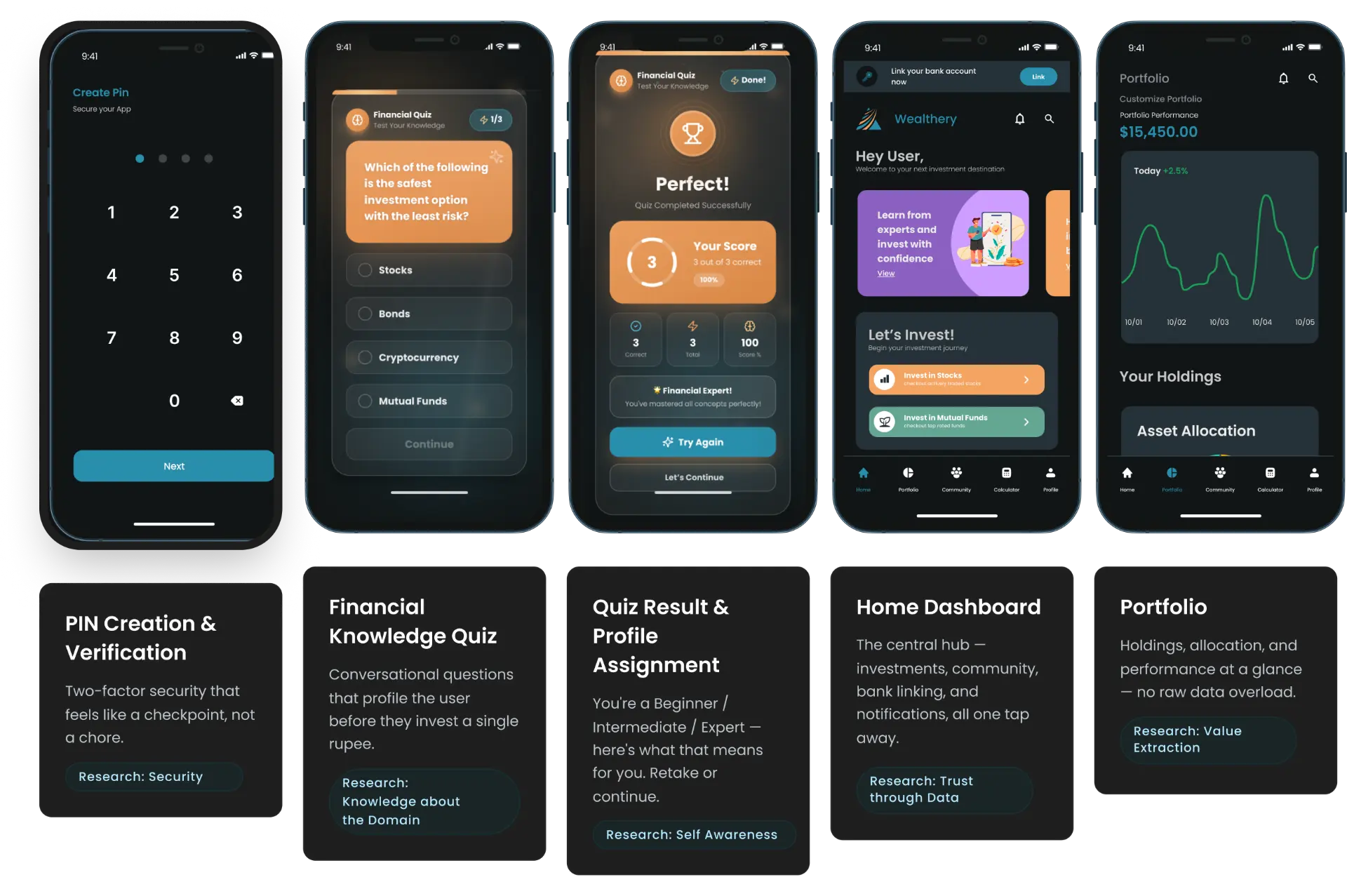
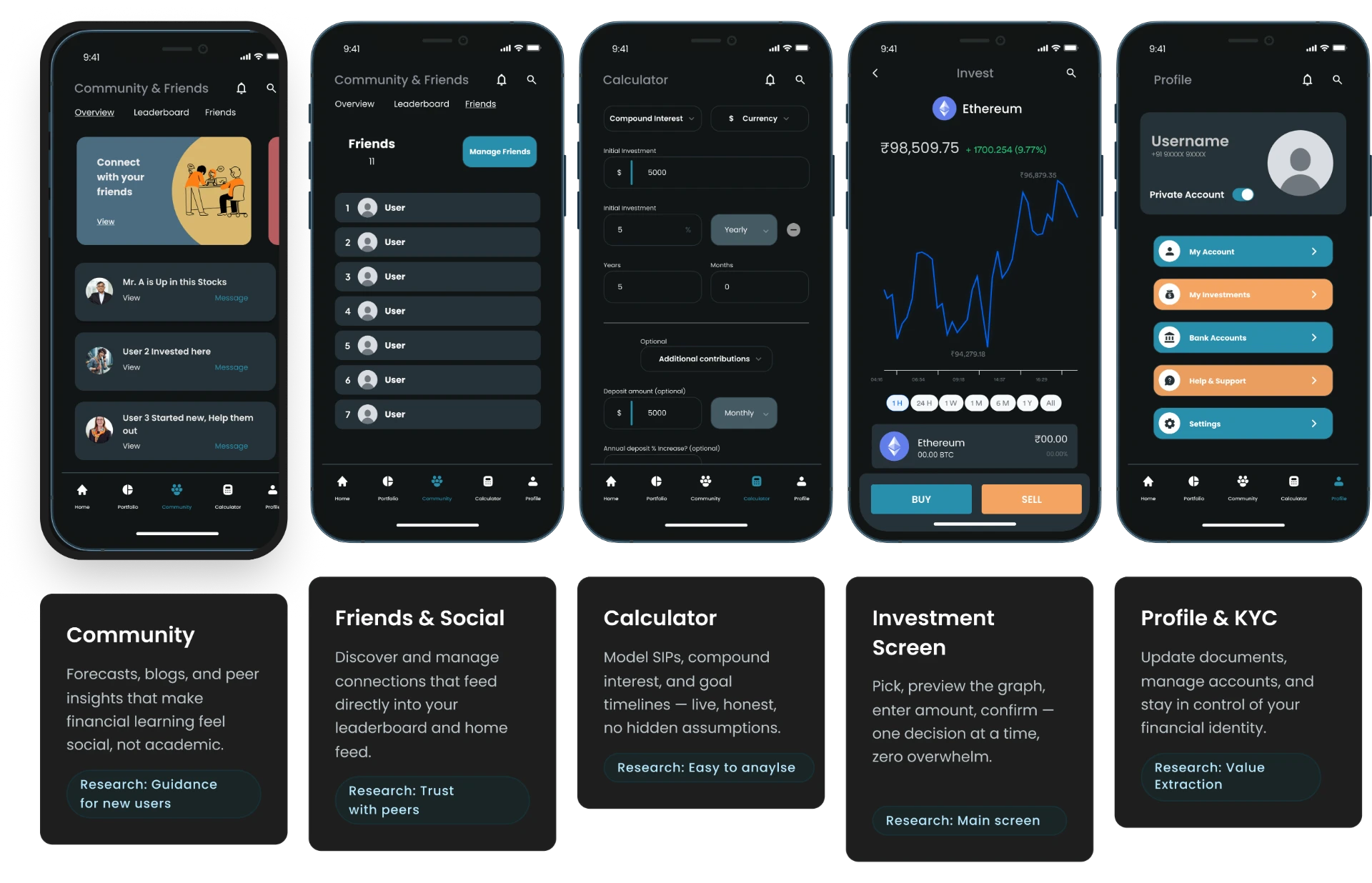
We put it in front of real people.
90% success rate, users navigated the Rebellion Portfolio flow with near-zero friction, proving the aesthetic never compromised utility.
Task success rate across critical flows
Diversified participants
High-friction critical tasks
Time to money (TTM)
"Finally, a finance app that doesn't feel like I'm filling out a tax return. It's raw, it's fast."
Crypto native, 24
"The graph paper grid makes me feel like I'm building a strategy, not just looking at a balance."
UX architect, 38
"I actually understand where my risk is for the first time without calling a broker."
Legacy disruptor, 45
What Wealthery delivers.
Measuring the impact of ethical fintech design on investor confidence and operational excellence, through quantitative and qualitative benchmarks.
Usability success, task completion for first-time investors on multi-asset portfolios
Time-to-invest, friction removed between onboarding and first deposit
Fee transparency sentiment on clarity of hidden costs
AA accessibility compliance across the interface
Personalised portfolio insights powered by LLM-driven market analysis.
Global deployment of contextual financial jargon explainers.
Deep-dive ethnographic studies for non-metropolitan growth.
Quarterly third-party review of screen-reader optimisation.
What this project actually taught me.
Design for fear
Investing involves real stakes. Fintech design shouldn't just be fast, it should be safe. Adding friction in high-stakes areas, like confirmation modals for large transfers, actually increased trust rather than hurting the experience.
Transparency as a feature
We treated fee breakdowns and market risks not as legal fine print but as a core UI component. That shift from hiding to explaining became the primary differentiator in a crowded Indian fintech landscape.
What I'd do differently
Early on I over-optimised for desktop power users. If I restarted, I'd take a mobile-only approach first for Tier-3 city users who rely entirely on smartphones for their financial literacy journey.
Jargon is a barrier, not a rite of passage
Every word that needs a definition the user doesn't have is a wall, even if removing it makes the product look less serious to insiders.
"Let's build the future of wealth."
Outcome
- [ADD REAL RESULT]